FRACTURE AND FRAGMENTATION OF ARMOR CERAMICS
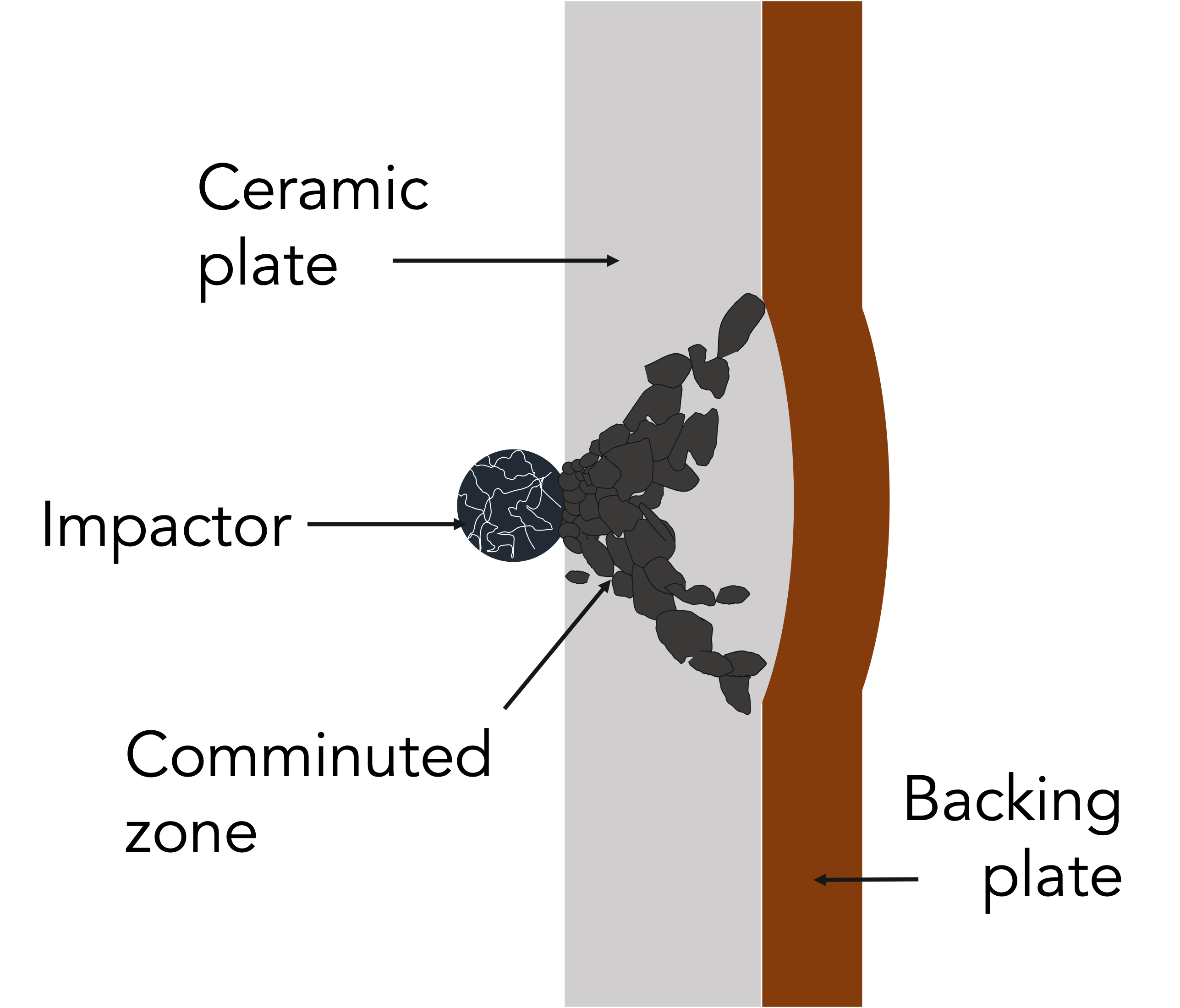
As a PhD student in the Graham-Brady group and the Hopkins Extreme Materials Institute, I have studied the dynamic behavior of armor ceramics with boron carbide as a model material. High hardness and low weight of boron carbide makes it suitable for body armors. During impact experiments, simultaneous growth and coalescence of multiple cracks lead to extensive fragmentation in the region right under the indenter, also known as the Mescall zone. Thereafter the material behaves as a granular solid, leading to energy dissipation and further comminution through granular flow. I have studied the influence of microstructural and mechanical properties on the transition of a ceramic from a cracked microstructure to a granular material and its subsequent granular flow. Understanding the sensitivity of model parameters of an integrated multi-scale and multi-physics ceramics model on impact performance not only assists in developing more predictive models but also provides guidance towards processing modifications that can improve performance and prioritize calibration experiments. I have also studied the dependence of the underlying microstructure on fragment morphology and the corresponding material design implications.
Size effect in concrete under compression
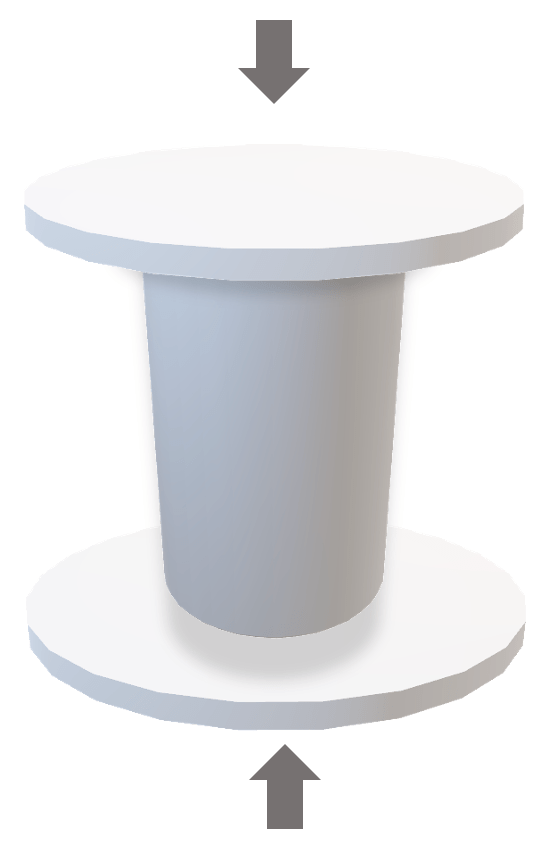
As a masters student in Prof. Arghya Deb’s lab at the Indian Institute of Technology, Karagpur my research was geared towards understanding the energetic size effect in quasi-brittle materials like concrete under compression for different platen conditions. Shear band failure in concrete cylinders was modelled via an inclined corner crack with a cohesive zone, and the effect of finite dimensions on crack growth was related to the compressive strength. Using a combination of boundary collocation methods with least squares optimization and Rice and Buckner’s weight function approach, the stress intensity factor of the aforementioned crack was solved and verified against J-integral solutions using the Concrete Damage Plasticity model in ABAQUS.
 Amartya Bhattacharjee